 Skip to content

What Is White Label SEO and How Does It Work? Complete Guide
Your SEO team is busy, and your client list is growing. You can hire additional SEO specialists, turn down new projects, or find another way to manage the increasing workload.
However, when workloads fluctuate, adding permanent staff can increase overhead costs without guaranteeing consistent returns.
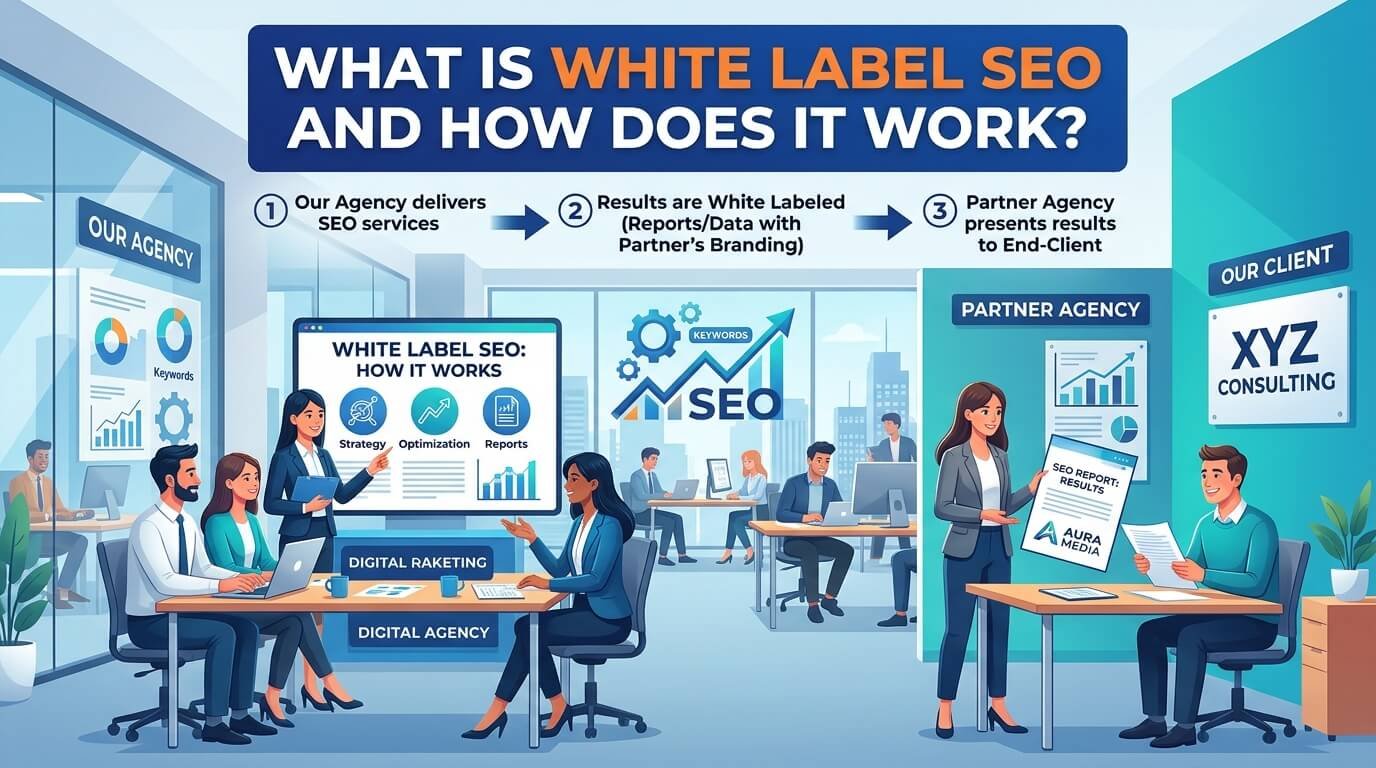
This is where white label SEO can help. By partnering with an external SEO specialist or agency, you can expand your service offerings, take on more client work, and maintain your client relationships while the delivery partner handles the agreed SEO tasks behind the scenes.
So, what is white label SEO, why might your agency need it, and how does it work? If you have these questions, you’re in the right place. Let’s break it down.
What is White Label SEO?
You probably understand the type of arrangement. To make it clearer, let us give you another example. In a different industry, like a cafe that sells cakes. As a customer, you know they sell the cakes. But who is making them?
Perhaps a local bakery. Now, the cafe is responsible for the experience, while the bakery meets the needs. White label SEO works with the same logic. The agency fronts the service, but the partner produces it.
This might confuse you with 3 common terms like:
- Outsourcing is doing the work for someone else.
- White label means the work is done by someone else and delivered under your brand.
- The white hat is a completely different concept. It means working within a search engine’s guidelines and has nothing to do with branding.
A good white label provider will work in a white-hat way, but the two terms aren’t interchangeable.
How does White Label SEO Work?
Take an example of a plumbing company in Leeds. They hire a white-label SEO marketing agency to help their website appear in Google searches. How does it work?
- Onboarding and Discovery: The agency agrees on the plumber’s goals (more boiler-repair inquiries in West Yorkshire, for example) and defines the scope and price.
- Partner Briefing: The agency sends the goals, website access and competitor data to its white-label provider, who then audits the site.
- Strategy: They agree on priorities such as keyword targets, fixes for slow pages, and improving your local search services
- Execution: The provider will research search terms, improve page content, fix technical issues, and build links where appropriate.
- Reporting: The agency reviews the work and then sends the plumber a report, bearing the agency’s name and logo, with results and recommendations in plain English.
- Continuous Improvement: Each month we meet to review performance and make any necessary changes to the plan.
- Payment: The plumber gets paid by the agency. The agency pays the provider and keeps the difference to cover its own costs, account management, and any profit.
Note that the agency is more than a passive middleman. It checks the work and remains the point of contact for the client.
Which Services can be Delivered through a White Label Partner?
A lot of essential SEO work can be tackled like this:
- Technical SEO: Think site audits, ensuring crawlability, boosting page speed, fixing structured data, and addressing indexing issues.
- On-page SEO: Craft titles, organize headings, strengthen internal linking, and optimize content.
- Content Marketing: Focus on creating keyword-driven articles, service pages, and helpful guides.
- Link Building: It’s all about earning valuable mentions and links from trustworthy sites.
- Reporting: Providing branded dashboards and monthly summaries is key. When it comes to content and link building, they really need a closer look.
Google’s spam policies look out for manipulative links and low-quality, mass-produced content, so agencies should ask how a provider handles both.
Who Should Use White Label SEO?
A white label SEO provider may not be for everyone, but if you work in the following industries, it can come in handy.
- Digital marketing agencies looking to add SEO to their paid media or social services.
- Web design agencies whose clients frequently wonder, “Will anyone discover my new site?”
- SEO consultants who find themselves needing additional support during busy periods. Agencies facing capacity issues that are either turning down projects or having a tough time finding new talent.
This approach may not be the best fit for agencies that prefer to maintain complete control over every task or don’t have someone to evaluate the provider’s work.
Benefits and limitations of White Label SEO
When you’re thinking of hiring, you must also consider the benefits and limitations of it too:
Benefits
- Service Expansion: You can enhance your offerings with SEO without needing to hire new specialists.
- Scalability: You can take on more clients without having to significantly increase your team size.
- Client Retention: By offering a wider range of services, clients are less likely to seek alternatives.
- Predictable Delivery Costs: Budgeting becomes simpler because it’s often easier to plan costs than salaries.
Limitations
- Quality Control: The agency’s reputation hinges on the quality of someone else’s work.
- Communication: Additional layers can slow down responses if the workflows aren’t clearly defined.
- Provider Dependency: If your partner doesn’t deliver or suddenly vanishes, your agency could be at risk.
- No Guaranteed Outcomes: There’s no way to promise rankings, and agencies should steer clear of making such guarantees.
- Margins are Not Automatic: Profitability relies on how you price your services, scope projects, and manage time spent on account management and quality assurance.
It’s important to keep a realistic perspective on transparency. While many agencies choose not to disclose their partners, we shouldn’t keep third-party involvement secret. It’s crucial to manage contracts, data-sharing agreements, and client expectations with honesty. Since providers will be accessing client data, UK agencies need to be mindful of UK GDPR obligations and ensure they have the right agreements set up.
Conclusion
With white-label SEO, agencies can expand their service offerings while keeping their client relationships and brand intact. The effectiveness of this strategy hinges on finding a reliable partner, consistently reviewing the work, and maintaining honest communication.
If you’re an agency considering this model, Newaytors offers full flash SEO services that are designed for agencies that want to expand without the burden of hiring an in-house team.
Do you need the best white label seo in the UK? Contact Newaytors to explore your needs and determine if a partnership aligns with your agency’s goals.
FAQs
Is white label SEO Agency legal and ethical?
Yes. Reselling services under your own brand is a typical commercial practice. The ethical part comes down to being truthful with your clients regarding what you’ll provide and not making any unsupported claims.
Is white label SEO the same as being an SEO reseller?
There’s definitely some overlap, but they’re not the same. Reselling focuses on the sales process, while white labelling puts the spotlight on delivering the service under your brand, ideally with your real involvement.
Will it work for ecommerce clients?
Yes, you can opt for a white-label e-commerce SEO company. As long as the provider has a solid grasp of product pages, category structures, and overall site architecture at scale. It’s a good idea to ask for some relevant e-commerce examples to get a better sense of their expertise.
How long before clients see results?
Remember that SEO is generally a long game; it often takes months rather than days. The results can vary depending on the competition and the state of the site, so it’s best to communicate that upfront.
